
The Quiet Brilliance of Terra
VAULT RECORD
Status: Foundational context
Scope: Pre‑Cataclysm Terran civilisation
Reliability: High, though shaped by later loss
The opening chapters of The Cataclysm of Terra describe a world not yet defined by fracture or urgency. Terra is presented as a civilisation of long equilibrium—one whose greatest achievement was not expansion, but alignment.
In this era, knowledge was neither hoarded nor weaponised. It moved through shared institutions, ritual practice, and lived craft. The harmonic arts governed architecture, agriculture, travel, and governance alike. Roads resonated. Halls responded to voice and presence. Monoliths were placed not to dominate the land, but to listen to it. The world itself is depicted as responsive—its leylines stable, its cycles predictable, its peoples attuned to subtle variation rather than dramatic change.
Political power, where it existed, was diffuse. Councils guided rather than commanded. No single culture claimed mastery. The twin centres of Lycéya and Vyrnos appear not as rivals, but as complementary hands shaping a single instrument. Their differences were methodological, not ideological. Harmony was not assumed—it was maintained.
The text is careful not to sanctify this age. It acknowledges that much of what survives is aspirational, filtered through memory and loss. Yet the consistency of surviving accounts suggests that Terra’s early brilliance was real, if fragile. The world functioned because its people accepted limits—on curiosity, on intervention, on certainty.
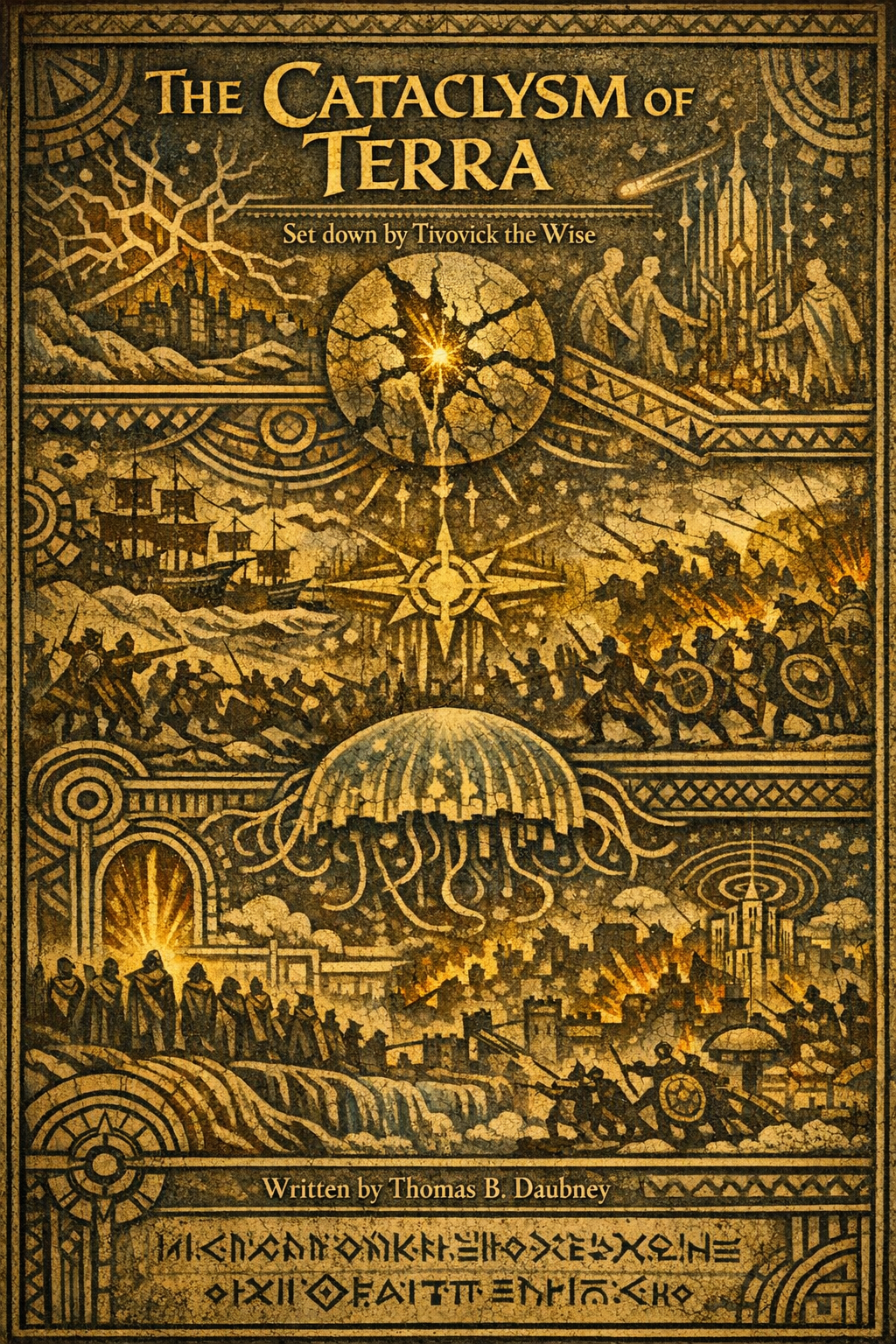
Even here, however, the record introduces a quiet tension. Confidence in harmonic mastery grows. Probing becomes more ambitious. Boundaries are tested not out of malice, but out of belief that understanding has outpaced risk. The earliest muralglyphs of this period already show hesitation in their lines—subtle distortions that later scholars would recognise as warning rather than ornament.
The brilliance of Terra lay not in perfection, but in balance sustained through attention. The tragedy that follows is not sudden. It is prepared by the assumption that such balance, once achieved, could endure without vigilance.