The Cataclysm of Terra
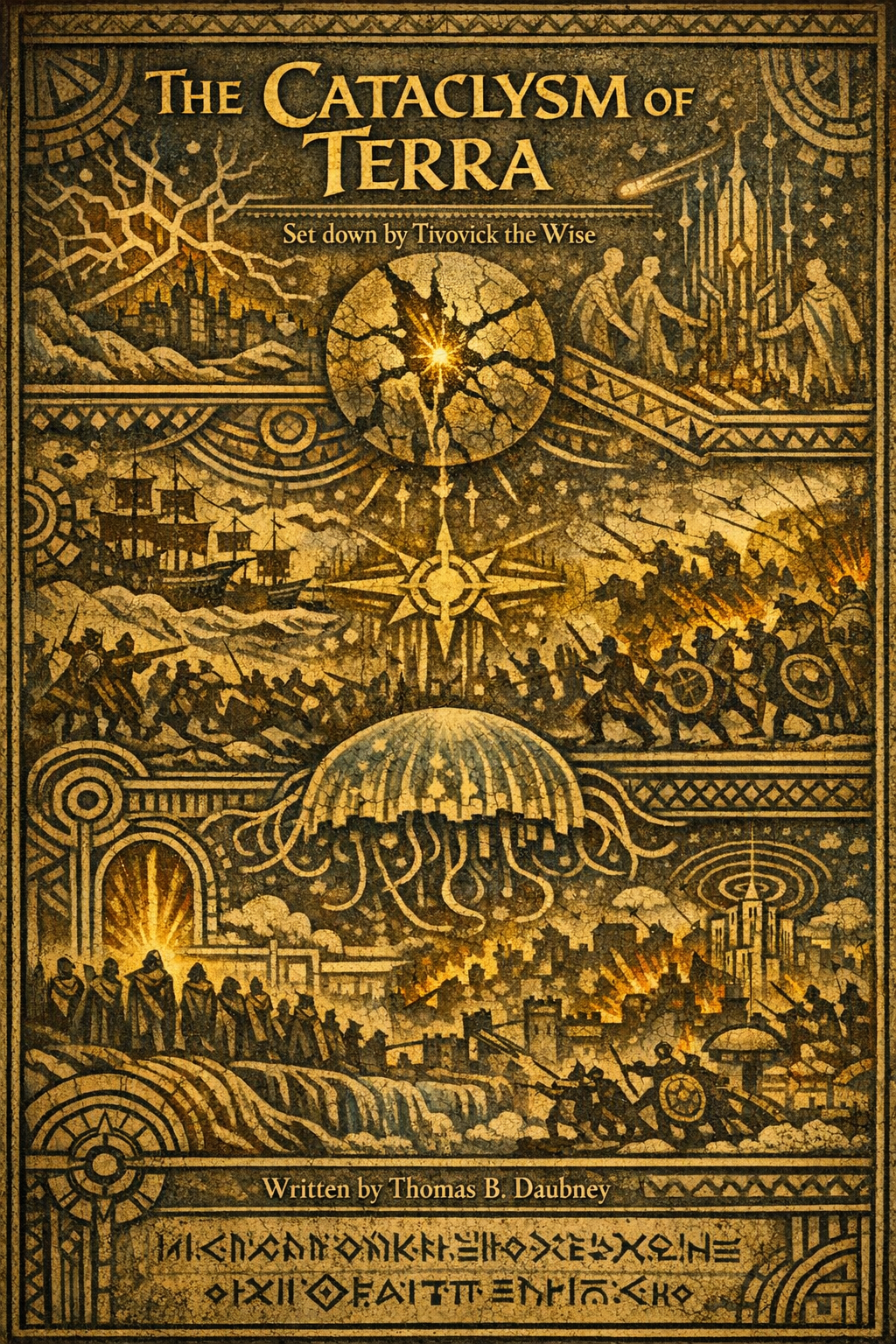

Table of Contents
1: The Quiet Brilliance of Terra | 7200BCE 2: The First Sign of Cracks | 7166-7099BCE 3: The Second Coming and a Fragile Victory | 7066–6999BCE 4: The Temptation of the Outer Voice | 6475BCE 5: Mangala’s Hidden Roots Take Hold | 6425BCE 6: The First Tremor in the Ley‑Grid | 4645BCE 7: Sanctions and Shadows | 3700BCE 8: The Siege of Ley and the Shattering of the World | 3622-3601BCE 9: The Sundering Millennia | 3601-1231BCE 10: Atlantis and the Forbidden Flight | 1231-1200BCE 11: The 1,200‑Year Weaving of Erdia – 1200BCE-0CE 12: The Tower of the Sun | 1BCE–0CE 13: The Last Note on Terra2: The First Sign of Cracks | 7166-7099BCE
The First Sign of Cracks
VAULT RECORD
Status: Early destabilisation
Scope: Initial astral probing and its consequences
Reliability: High, though interpretation remains contested
The second movement of The Cataclysm of Terra marks the first departure from equilibrium. It does not describe an invasion, nor an act of malice, but a moment of overreach—measured, deliberate, and undertaken with confidence born of long success.
The sages of Terra initiated a series of astral probings intended to test the limits of their harmonic understanding. These were not reckless acts. They were precise, ritualised, and governed by established safeguards. Yet the record is clear that the membrane they pierced was thinner than anticipated, worn by pressures accumulated across ages rather than moments.
What answered the probing is not described as a being in any conventional sense. The earliest muralglyphs depict inversion rather than form—a pressure applied to the world’s deeper chords, forcing dissonance into a system unprepared to absorb it. Later scholars would name this intrusion Phosphorus, though the text itself treats the name with caution, acknowledging uncertainty as to whether it denotes an entity, a substance, or a condition.
The immediate effects were subtle but unmistakable. Temple shields strained. Leylines wavered. Mountains shuddered without collapse. The sound most often recorded is not thunder, but something closer to a scream contained within stone. These disturbances did not destroy Terra’s harmony, but they revealed its vulnerability.
The response of Terran civilisation was neither panic nor denial. Cultures adjusted. Vaults were reinforced. Tools were refined. The protodwarves deepened their fortifications; the Dracokin forged implements of unfamiliar precision. These actions are recorded not as fear, but as recognition—an understanding that something vast had pressed against the world, and that the world had endured, but not unmarked.
The muralglyphs of this period are notable for their restraint. The inverted figure is rendered hesitantly, its edges frayed, its outline incomplete. The artists appear unwilling to grant it definition, as though clarity itself might invite further attention. Silence surrounds these records. Speculation is absent. The absence is deliberate.
This chapter establishes a critical pattern that will recur throughout the Cataclysm: Terra does not fall because it fails to respond. It falls because it responds without fully understanding what has been invited into its systems. The first crack is not a rupture. It is a question left unanswered.
Find your way!
Resources
WHO WE ARE
LEGAL
Listen to our Podcast